
The £258bn is real. Calling it a gap is the mistake.
The Armitt report is right about the number and wrong about the issue. Britain does not have an infrastructure funding gap. It has a structuring gap, and the unit of structuring is no longer the nation.

Sir John Armitt's Public Private Partnership Commission put a number on Britain's infrastructure problem this week, and it deserves to be taken seriously. £258bn. About £25bn a year more by 2030, a two-thirds increase on what we currently invest, or roughly £590 a year from every adult in the country if we choose to fund it through tax. Borrow it instead and the report puts the added debt interest at £7bn a year by 2030, £14bn by 2035 and £23bn by 2040. Armitt's conclusion is that anyone who believes the taxpayer and the public sector can close that alone has not looked at the public finances, and on that he is plainly right.
Three things in the report I would agree with up front. The first is the honesty of the arithmetic. Putting a per-adult tax figure on the ambition is a public service, because most of the infrastructure conversation in this country is conducted as though the choice were between building things and not building things, rather than between different people paying at different times. The second is that political risk is a genuine cost of capital and not a grumble from the investor lobby: stop-start pipelines, re-costed schemes and changed specifications get priced, and we are the ones who pay the price. The third is that the underinvestment is long-run and structural. Oxford Economics, in work published last week for the airport groups and infrastructure investors, put the cumulative shortfall against the G7 at £1.9tn over twenty-five years, with the UK investing 18.9% of GDP in 2025 against an OECD average of 22.5%. This is not a Parliament-sized problem.
Where I part company is the word gap.
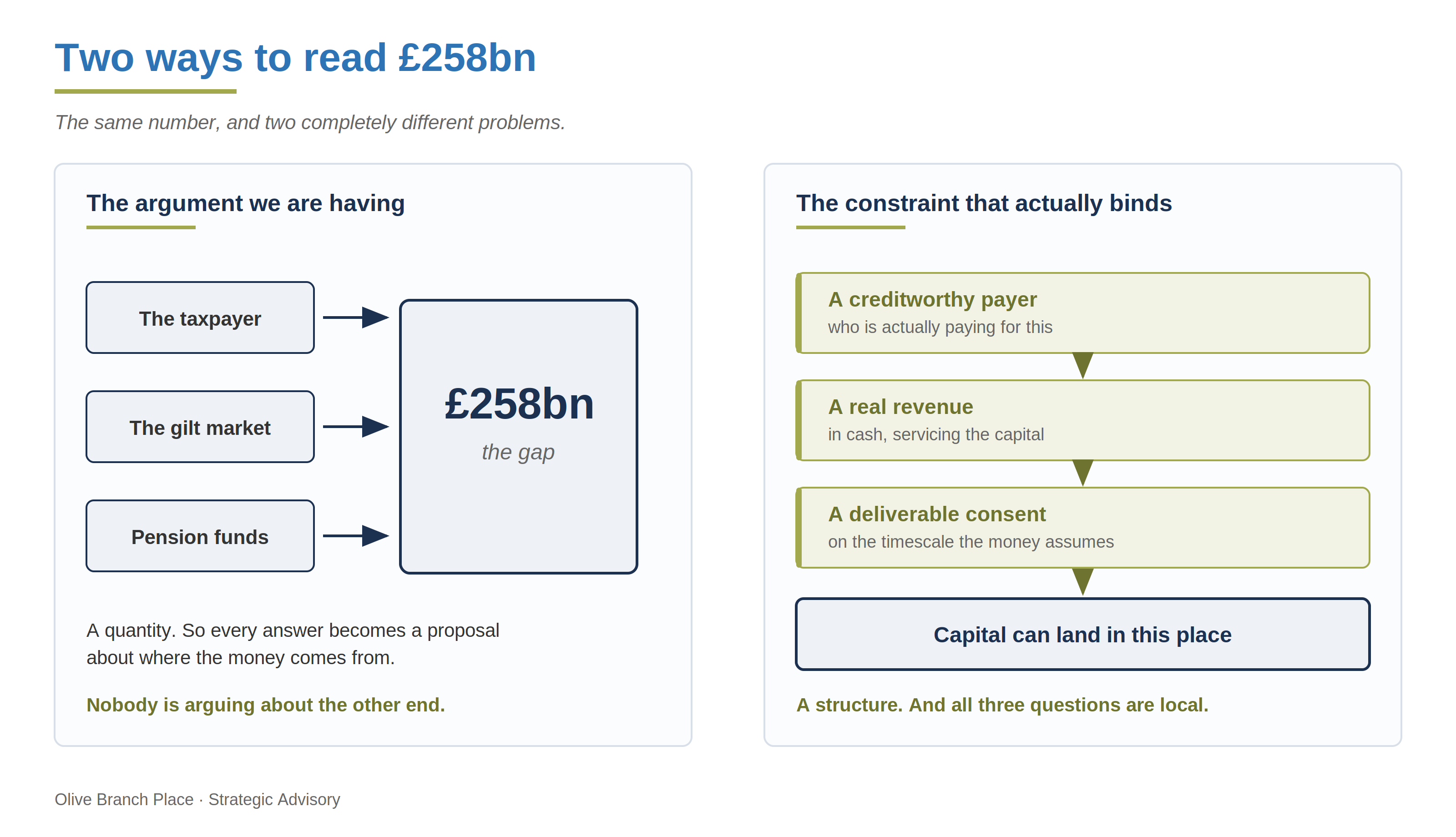
A gap is a quantity. Frame the problem as a quantity of missing money and every answer becomes a proposal about where the money comes from: the taxpayer, the gilt market, the pension funds. That is precisely the argument we are now having, with the Commission on one side saying bring in private capital and the IPPR on the other saying revisit the fiscal rules, both working from the same G7 comparison and arriving at opposite prescriptions. What neither side is arguing about is the thing that actually determines whether a pound of anybody's capital can be deployed into a place, which is whether there is something there to buy.
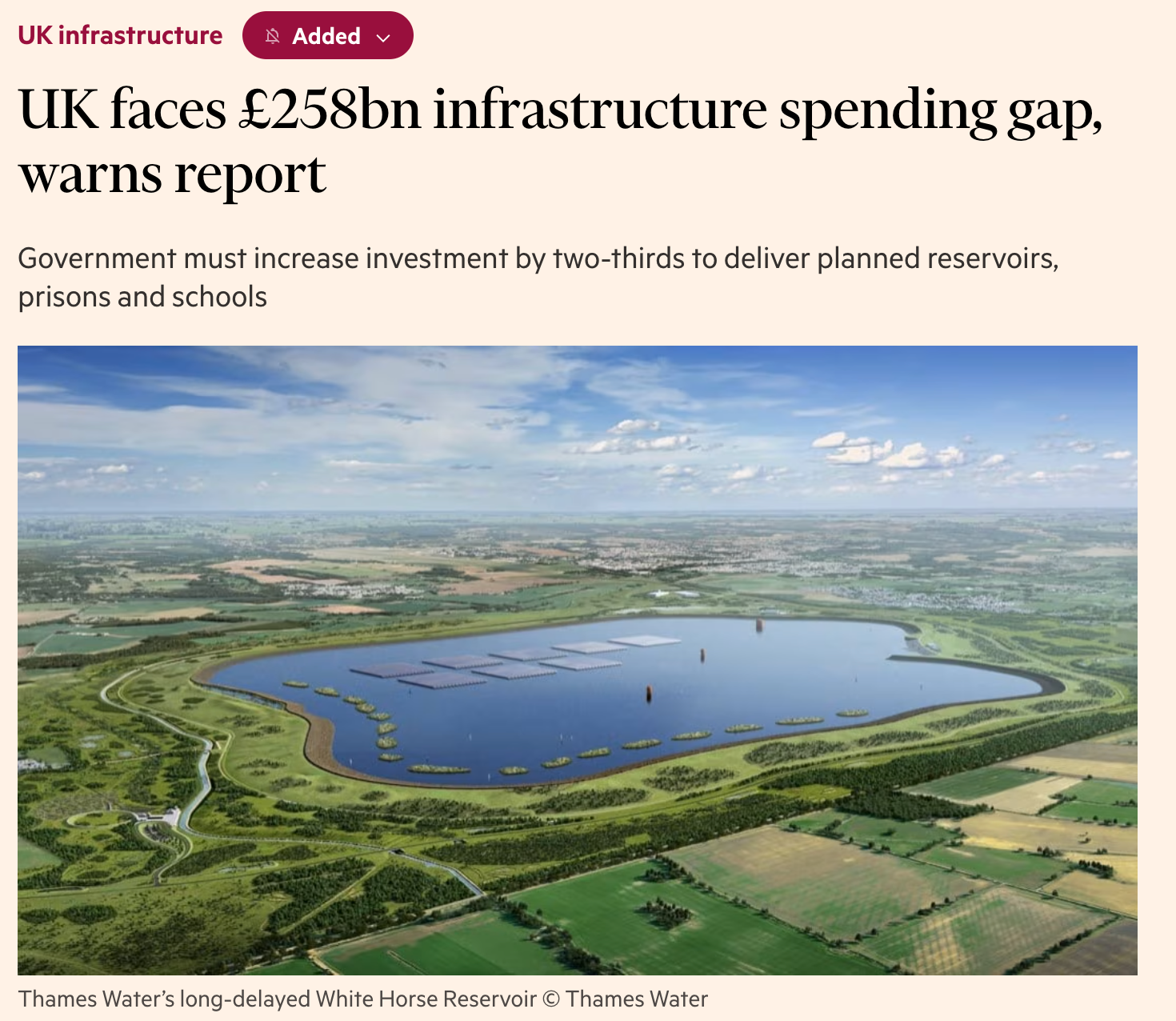
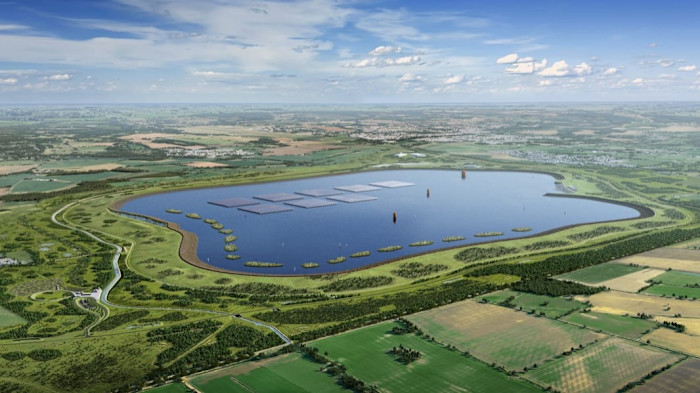
The tell sits in the report's own headline example. The scheme held up as what the gap prevents is Thames Water's White Horse Reservoir. That project sits inside a regulated asset base, which is to say it is already a private finance model with a defined revenue stream, and it still has not been built. Its problem has not been an absence of capital. Its problem has been consent, regulatory process, and a counterparty whose creditworthiness is currently the subject of a stand-off with government. You can pour £258bn into the top of that system and the reservoir does not arrive any sooner.
Then there is the timing, which I suspect will turn out to be the quietly awkward part. The Commission's central planning ask is a parliamentary confirmatory vote for critical national infrastructure, to end what Armitt calls the horrible merry-go-round of legal challenges. On 7 September, a week before this report landed, the Chancellor's pre-Budget growth statement committed to parliamentary designation of critical infrastructure with enhanced legal protection, a fixed challenge window, and legislation to cut back statutory consultation. The Attorney General followed the next day with guidance telling government lawyers that a decision is unlawful only where no tenable legal argument supports it. Whatever you make of that package, the door the Commission is pushing at is already open.
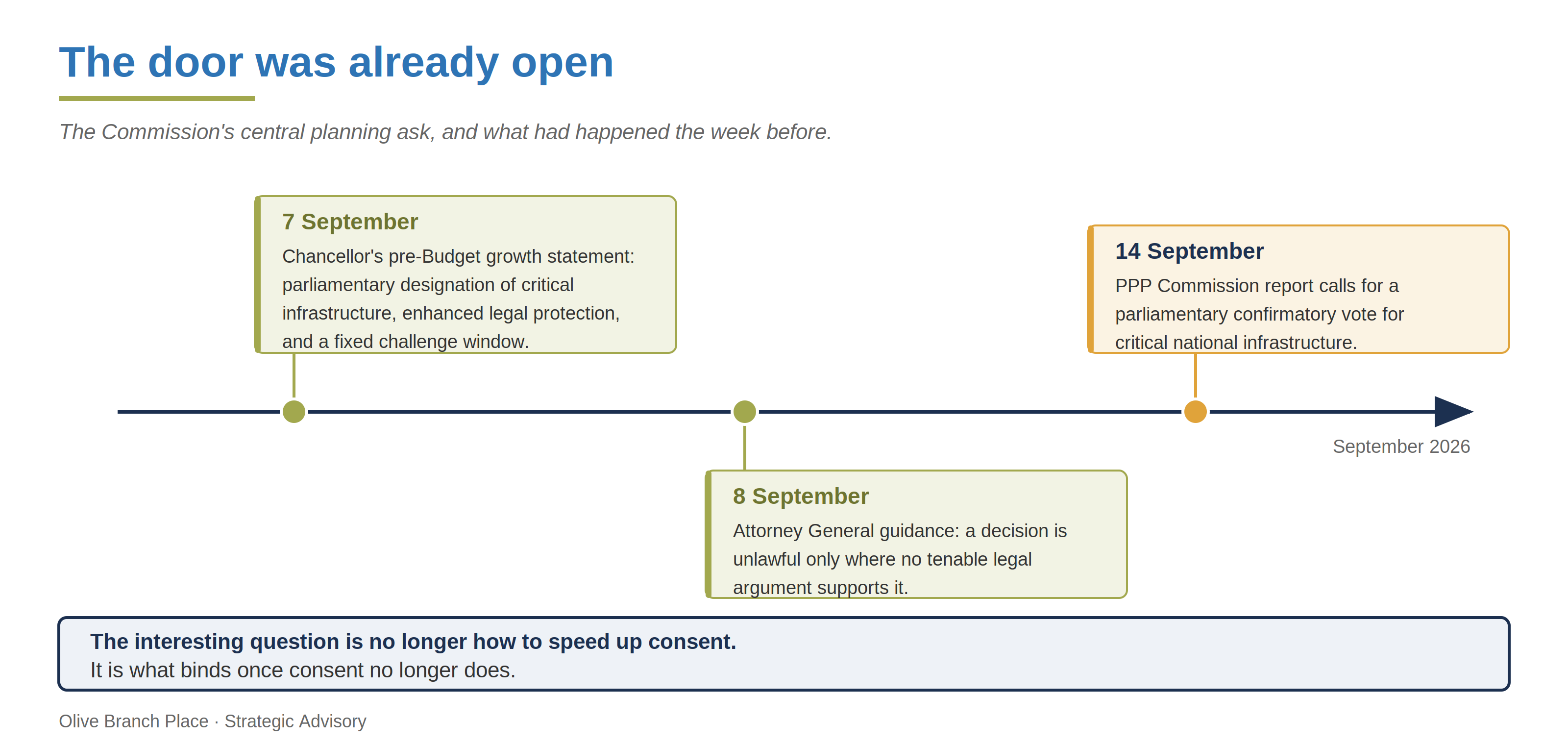
Which raises the more interesting question, and the one I would like the sector to spend this autumn on. If consent stops being the binding constraint, what is?
My answer, from working with authorities who are trying to assemble actual pipelines rather than argue about national aggregates, is that you are left standing in front of three much harder questions, and all three are local. Who is the creditworthy payer for this particular thing. What is the revenue, in cash, that services the capital. And is the consent deliverable on the timescale the money assumes. Everything else is presentation.
That is also why the pension argument in the report, which is directionally right, is diagnosed wrongly. Trustees are not sitting on trillions of pounds declining to invest in Britain out of sentiment, and they will not be argued into it. They hold a fiduciary duty to buy risk-adjusted return, and most place infrastructure in this country is too small, too bespoke, too early, and too dependent on a public counterparty who has not yet said what they are paying for. That is a product problem. It gets solved by aggregation, standard vehicles and credible underwriting, not by exhortation and not by another independent commission.
The actor missing from the whole debate is the one we have just spent two years creating. On the government's own commitment of 7 September, every area of England will be in the process of establishing a strategic authority by the end of 2027, with strategic authorities in place everywhere by the end of 2028. Those bodies will hold spatial development strategies and integrated settlements, and in mayoral areas the call-in and development order powers that come on stream from early 2027. If the fiscal devolution roadmap expected at the Budget on 28 October means anything, some of them will hold assigned revenue as well. A spatial development strategy is not a large local plan. It is the first instrument we have had that can state, for a real geography, what is being built, in what order, against which infrastructure, and paid for by whom. That is where a national number either becomes a buyable proposition or does not.
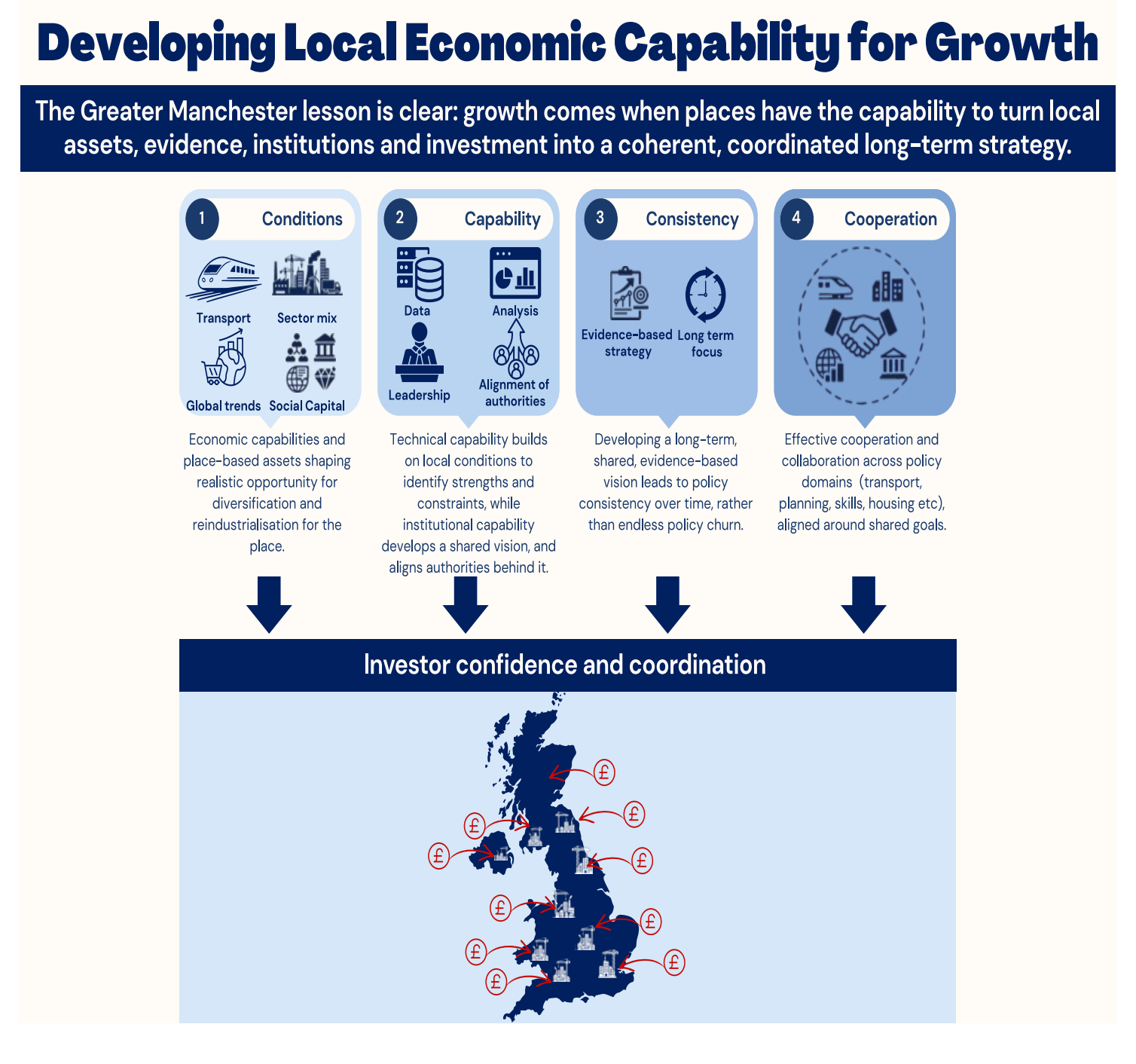
So I would take the £258bn seriously, and then stop talking about it. The gap will not be closed by a better argument about the source of the money. It will be closed place by place, by people doing the unglamorous work of turning a spatial strategy into a pipeline with named payers attached to it.
I would genuinely like to hear from anyone who thinks that is too relaxed about consent, or too hard on the capital-mobilisation case. From the investor side especially: what would actually have to be true of a mayoral pipeline before you would price it?
Paul Frainer is Managing Director of Olive Branch Consulting and a partner in the Strategic Planning Partnership, working with combined and strategic authorities on spatial development strategies and investment pipelines.